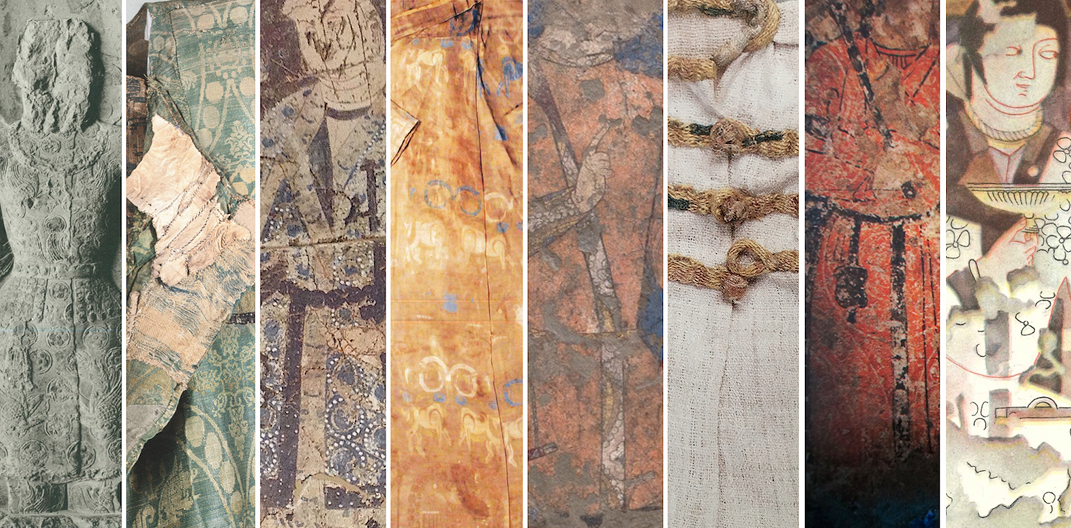
This book project investigates how a particular garment type, the kaftan, enabled cross-cultural communication across a continent.
Previous scholarship has treated the kaftan as a nomadic riding ensemble adopted by settled populations for practical reasons. However, I argue that in the fifth century CE, communities across Eurasia began to consistently construct a novel garment type according to four hallmark design features: sleeves, a fitted bodice, attached skirting, and overlapping front panels that can form lapels. This flexible but distinctive combination of features encouraged communities to modify, customize, and adorn other aspects of the garment (for example, the fabric pairing and hem length) while maintaining its recognizability. Furthermore, these personalizations did not inhibit the hallmark convertible lapel, which allowed wearers to style and re-style their garment in numerous ways instantaneously. Although the communities that adopted the kaftan were exceptionally diverse – empires, city-states, and nomadic polities– all of them placed the kaftan at the center of their sartorial systems. As a result, regional systems began to overlap, some mildly brushing edges and others layering over one another. As an internationally recognized fashion, the kaftan became a critical tool for cross-cultural communication.
This book project builds on my doctoral dissertation, "The Age of the Polychrome Kaftan: Sartorial System of Central Eurasia 400-900 CE," completed for my PhD in the Department of the History of Art at Cornell University.
Link to Cornell University Library eCommons site